XRP Ledger Launches Private DEX for Banks and Institutional DeFi
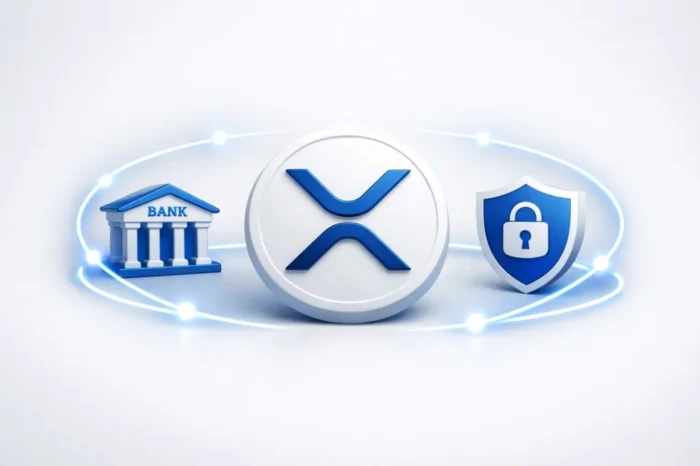
The XRP Ledger blockchain has taken one of the most significant steps in its history towards traditional financial institutions. On February 18, 2026, the XLS-81 upgrade known as Permissioned DEX was activated on the mainnet. For banks and brokerage houses that have been on the fence about DeFi for years, hesitant to enter due to regulatory restrictions, this could prove to be a real game-changer.
What is Permissioned DEX and how does it differ from regular DEX
The existing DEX on XRP Ledger is an open system: any participant can place and accept orders without any prior verification. This is a key principle of decentralization, but it was precisely this that closed the way for banks, hedge funds and brokers, who are obliged to know their counterparties.
Permissioned DEX solves this problem differently. The domain administrator creates a list of allowed participants verified through KYC and AML procedures. Only accounts with verified credentials can post and accept offers within such a domain. At the same time, open DEX does not disappear anywhere – both systems operate in parallel on the same blockchain.
82.35% of network validators supported the update. Ripple CTO David Schwartz described the approach as “compliance without sacrificing decentralization, fee savings and user control.”
Two updates that work together
The launch of Permissioned DEX was part of a series of institutional upgrades. A week earlier, on February 12, the XLS-85 standard was activated on the network – an extension of the escrow system beyond the native XRP. Conditional transactions are now available for any token on XRPL, including stablecoins like RLUSD and tokenized real assets (RWA).
Together, the two updates provide regulated players with a complete toolkit: escrow closes the issue of escrow settlements, and Permissioned DEX covers secondary trading in accordance with regulatory requirements. For a bank that wants to issue a tokenized bond and organize its trading within the framework of compliance, the chain is now closed on one blockchain.
Who will benefit from the launch
Direct beneficiaries are banks, brokers and asset managers seeking the speed of blockchain settlements without abandoning regulatory standards. Institutions already mentioned that are associated with XRPL include Mastercard, BlackRock and Franklin Templeton.
Market statistics are also indicative: according to RWA.xyz, XRP Ledger took second place in terms of growth in the volume of tokenized real assets over the past 30 days. 63% of tokenized US Treasuries are already on the XRPL network. Permissioned DEX creates a secondary trading mechanism for them.
Analysts warn of one risk – fragmentation of liquidity: if many isolated permissioned domains for similar instruments appear on the network, this could widen spreads. The solution is standardization of credentials and cross-domain routing mechanisms, which have yet to be developed.
What’s next for XRPL
The team’s plans for 2026 include introducing the Confidential Transfers function to hide transaction amounts (a requirement of a number of institutional clients), as well as launching a lending protocol directly in the base layer of the network. With the CLARITY Act actively moving forward in Congress, which will create regulatory clarity for digital assets in the US, institutional momentum for XRPL could increase significantly.
News highlights
- On February 18, 2026, Permissioned DEX (XLS-81) was activated on XRP Ledger – a closed exchange with KYC/AML control for regulated organizations
- Upgrade approved by 82.35% of network validators
- Works in conjunction with XLS-85 Token Escrow, activated on February 12: together they form the infrastructure for regulated institutional DeFi
- XRPL ranked second in growth of tokenized real assets over the last 30 days
- 63% of tokenized US Treasuries are already listed on the XRP Ledger
network
The information is for informational purposes only and under no circumstances constitutes individual investment advice. Investments in cryptocurrencies and digital assets involve a high risk of capital loss.

The crypto market isn't just about numbers—it's a complex ecosystem where politics, technology, and economics intertwine. In my news coverage, I strive not merely to recount events, but to analyze their real impact on the market. My goal is to make cryptocurrency news clear, accessible, and objective.