Rate, price, forecast and prospects for SOL – all in one material
What is Solana: cryptocurrency for those who don’t like to wait
Solana (ticker SOL) is a blockchain platform and cryptocurrency of the same name, created for high-speed and cheap transactions. Simply put: if Bitcoin is digital gold for storage, and Ethereum is a powerful but slow computer, then Solana is an expressway without traffic jams and tolls.
The Solana cryptocurrency is in the top 5 by market capitalization and has become one of the main altcoins of the last cycle. It is on the Solana blockchain that most of the memcoin trading, NFT drops and DeFi applications of 2023–2025 will take place.
Why Solana blockchain is needed: the problem it solves
Old networks – Bitcoin and Ethereum – suffer from one disease: the more users, the higher the fees and the longer the wait. At its peak, one transaction on Ethereum cost $50–100. This is not acceptable for gaming, payments or trading.
The Solana blockchain was created specifically for high loads. Its architects studied the mistakes of their predecessors and built speed into the protocol from scratch – not as an add-on, but as a foundation.
How Solana works: technology without further ado
The main innovation is the Proof of History (PoH) algorithm. Imagine a queue where each visitor already has a ticket with the exact time of arrival – no one argues who is first. This is how PoH orders transactions: each one receives a cryptographic timestamp, and the network does not waste time agreeing on the order between participants.
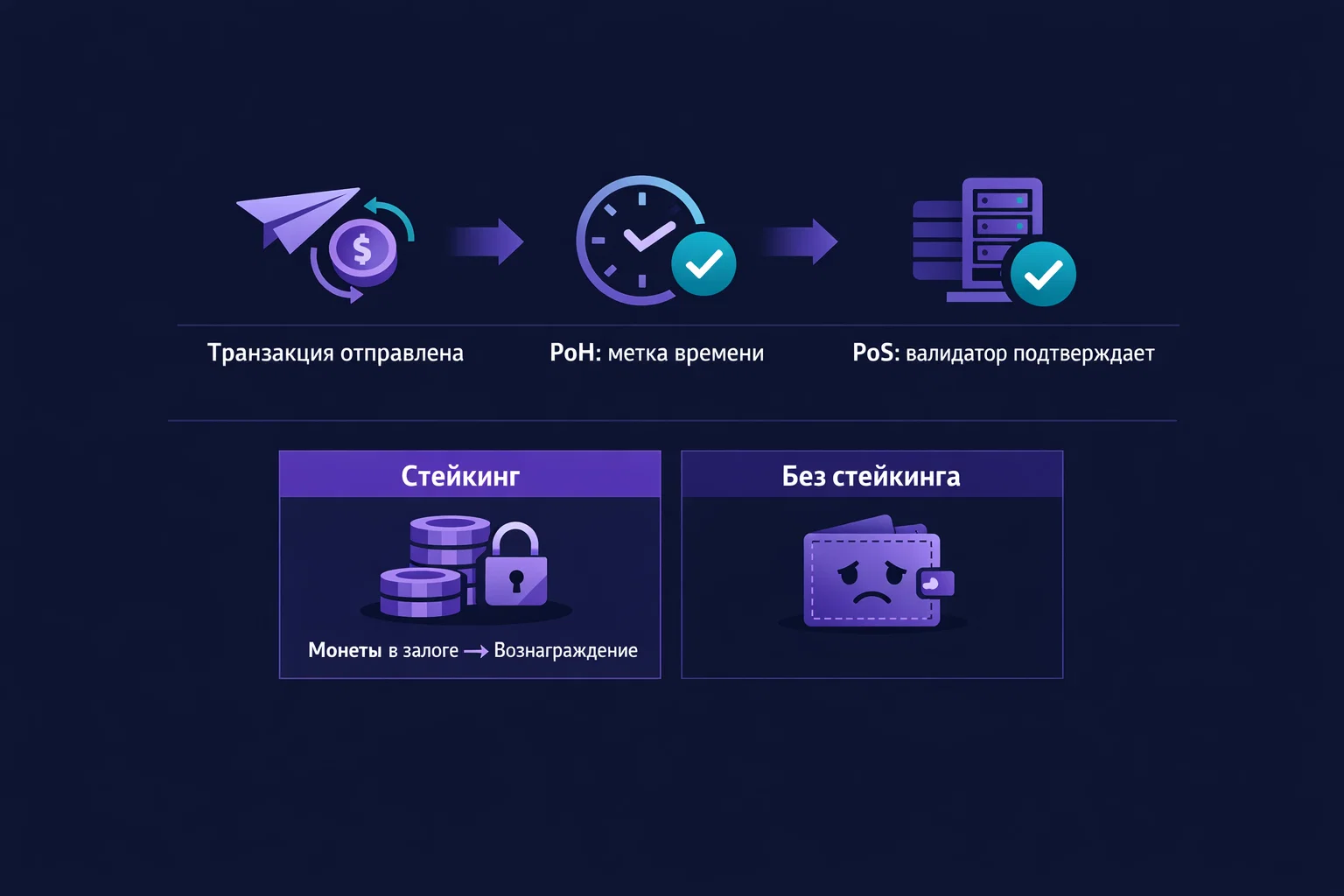
In conjunction with PoH, Proof of Stake (PoS) works: validators who hold Solana coins as collateral confirm transactions and receive rewards. This is staking – one of the ways to make money on SOL without trading.
In addition, the network has:
- Sealevel – parallel execution of smart contracts (in Ethereum they take turns)
- Turbine – breaking data into packets for fast transmission
- Gulf Stream – pre-processing of transactions before block finalization
Result: up to 65,000 transactions per second with a commission of less than a cent. For comparison, Ethereum processes about 15–30 TPS.
History and team: who is behind Solana
The project was founded in 2017 by Anatoly Yakovenko, a former Qualcomm engineer. The name is given in honor of Solana Beach in California, where Yakovenko lived while working on the protocol. In 2020, the Solana blockchain launched into the mainnet.
Solana Labs and the non-profit Solana Foundation are behind the project. A team with a background from Qualcomm, Google and Intel – engineers who know how to build high-load systems.

Solana cryptocurrency rate: price and tokenomics SOL
The Solana coin (SOL) does not have a hard issue limit like Bitcoin. Instead, there is a decreasing inflationary model: 50% of each commission is burned, which partially compensates for emissions. The current circulating supply is about 450–550 million SOL.
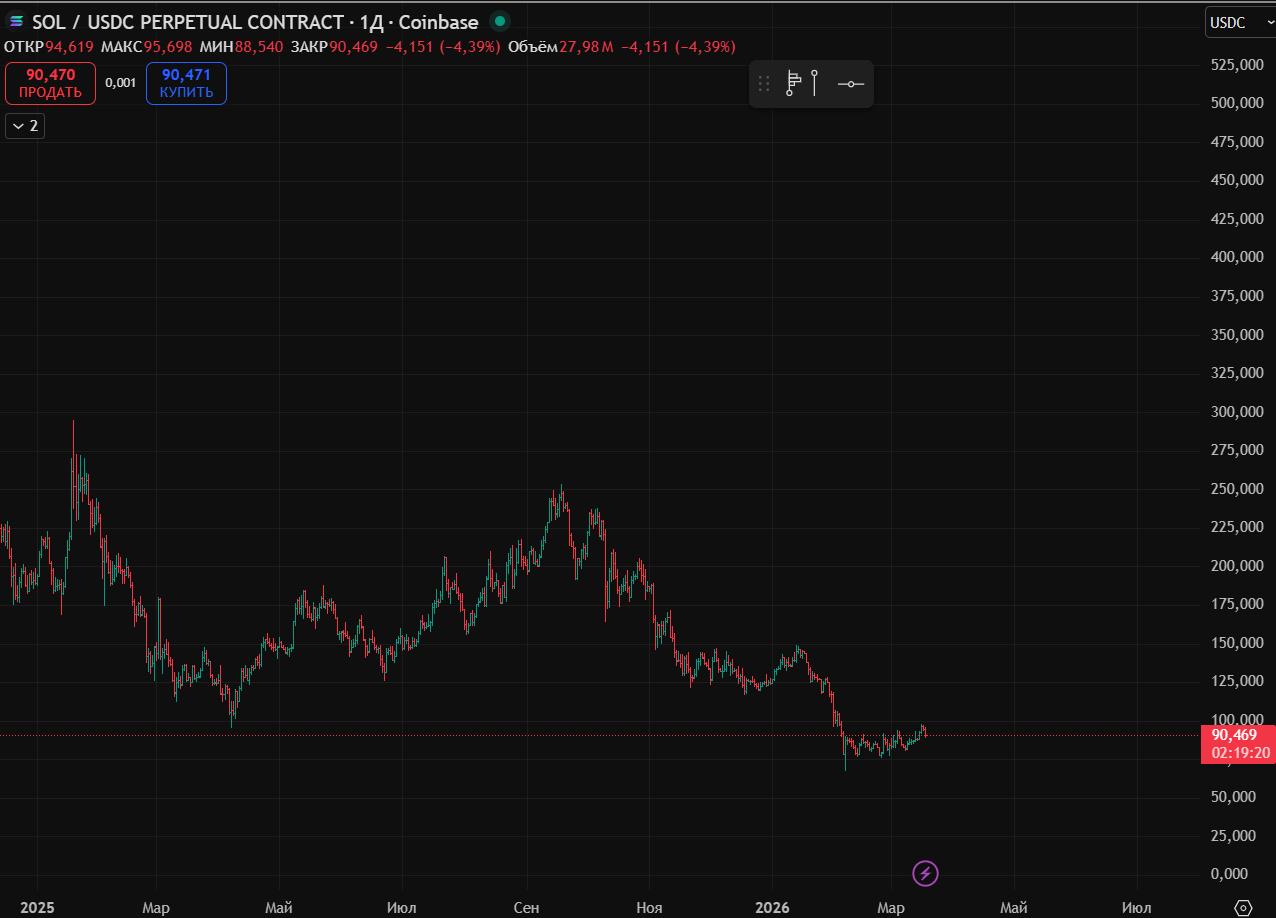
The Solana cryptocurrency chart is characterized by high volatility. The ATH (All-Time High, all-time high) was reached in November 2021 around $260. After the collapse of FTX in 2022, the rate fell to $8 – Solana Lab was among the projects affiliated with the Sam Bankman-Fried exchange. But it was this recovery from $8 to new highs in 2024-2025 that became one of the main stories of the crypto market.
You can follow the current exchange rate of the Solana cryptocurrency in dollars on CoinMarketCap, CoinGecko and TradingView.
Where to buy Solana (SOL)
SOL cryptocurrency is available on all major centralized exchanges: Binance, Bybit, OKX, Coinbase. For purchases without registration – decentralized exchangers within the Solana blockchain itself: Jupiter, Raydium.
The easiest way for beginners is to use Binance or Bybit: registration, verification, purchasing SOL for rubles or dollars through a card.
Ecosystem: what’s happening in the Solana blockchain
Solana has become home to real-time applications: gaming, NFTs, trading bots, high-frequency DeFi. Among the largest projects are the DEX aggregator Jupiter, the NFT marketplace Magic Eden, and the payment solution Solana Pay.
According to the beginning of 2026, the network processes over 100 million transactions per day – more than most competitors. In 2025, more than 11,500 new developers joined the ecosystem.
Competitors: Solana vs Ethereum and other altcoins
The main rival is Ethereum, which has an incomparably large ecosystem and institutional trust. Avalanche, Aptos, Sui also compete.
The key advantage of Solana is that it does not require Layer 2 networks: the blockchain scales natively. Ethereum with its L2 solutions (Arbitrum, Optimism) is more difficult for a beginner and splits liquidity between chains.
Risks: what could go wrong
Failures in the past. In 2021-2022, the network stopped several times due to congestion. Since 2025, uptime has remained above 99.9%, but the reputational aftertaste remains.
Dependence on memcoin speculation. At the beginning of 2026, the Solana memecoin economy collapsed: weekly DEX volume fell by more than half. At the peak of speculation, memcoins accounted for almost half of the network’s “GDP” – this is an unhealthy addiction.
Centralization of validators. To operate a node you need powerful and expensive equipment – the entry threshold is higher than that of Ethereum.
Contact with FTX. Although Solana has recovered, the toxic association with the bankrupt exchange periodically comes up in discussions.
Forecast for Solana: prospects for the SOL cryptocurrency
Analysts are divided, and this is an honest signal: Solana is not an obvious story.
The case for growth: The update to Firedancer (a new C++ client) promises a tenfold increase in performance and reduced risk of crashes. The volume of stablecoins on the network has reached historical highs – capital is not leaving, but is being rotated from memcoins to DeFi. This is a sign of a maturing ecosystem.
Arguments for caution: without the memcoin rush, the network’s commission income fell. Competition with Ethereum and new L1 blockchains continues unabated. Regulatory uncertainty in the US continues.
The Solana cryptocurrency is not a stable asset, but a highly volatile instrument. SOL price forecasts in the range of $100–$500 for 2025–2026 are available from various analysts, but any figures here are probabilistic scenarios, not guarantees.
Conclusion: is it worth paying attention to Solana
Solana is one of the most technically strong blockchains in the industry. Real users, real applications, real transaction volume. This is not hype without a foundation.
The big question for 2026 is whether the ecosystem can transition from the memcoin model to sustainable financial applications and payments. If yes, the Solana cryptocurrency will remain in the top. If not, the pressure on the exchange rate will continue.
Beginners: study the project before purchasing. Don’t invest more than you are willing to lose.
Traders: Monitor Firedancer and TVL (Total Value Locked) updates as key metrics.