What is DeFi and how do they work?
With the advent of the digital economy, it became possible to create a new system for generating income. DeFi (Decentralized Finance) is a decentralized ecosystem of financial applications and services that uses blockchain technology to provide financial services without the involvement of intermediaries such as banks and insurance companies.
In the article we tell in more detail what the DeFi sector is, about its strengths, problems and give examples of its use.
What is DeFi in simple words
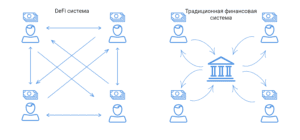
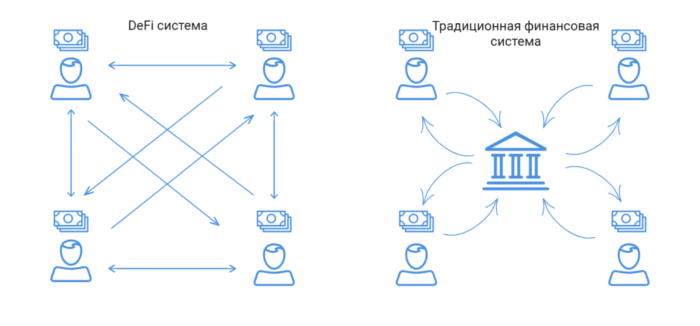
DeFi is a decentralized financial system that operates without intermediaries and is not governed by large institutions. Let’s give a simple example.
In everyday life, to get a loan you need to go to the bank. Before issuing a loan, employees of a banking institution carry out a procedure to verify the client’s identity, based on his passport data, and also check his financial stability, after which they make a decision on providing a loan service. The bank has the role of a centralized management body, which has the ability to refuse or approve an application.
Centralized cryptocurrency exchanges such as Binance or other platforms that require account creation may also apply similar measures, including blocking user profiles. After the imposition of sanctions on Russia in 2014, some crypto exchanges blocked user accounts with complete confiscation of assets. All this applies to a centralized financial system.

Decentralized finance is built on top of the blockchain and operates on smart contracts that carry out financial transactions. This structure gives each network participant the right to execute transactions and control their authenticity.
Distributed data storage provides a high level of security, since there is no single point of vulnerability. This means that the segment is difficult to attack or control.
DeFi includes a wide range of financial services, such as:
- lending;
- cryptocurrency exchange;
- staking;
- insurance and much more.
Users send and receive money without intermediaries and tax authorities. This gives each network participant freedom and full control over digital assets.
Reasons for DeFi popularity
DeFi provides access to financial services to any user, including those who were previously excluded from traditional financial systems or are under sanctions. People can participate in DeFi with only access to the internet and cryptocurrency assets.
The popularity of DeFi is due to a number of key factors:
Despite all these benefits, it should be noted that using DeFi still comes with risks, such as smart contract vulnerabilities and cryptocurrency price volatility.
How decentralized finance works
To provide users with access to decentralized finance, developers create websites and mobile applications where the functionality is integrated into blockchain protocols.
Users only need to create or connect their cryptocurrency wallet to the network, and after that DeFi opportunities become available.
Best DeFi services
Below we provide you with a table with DeFi services and their main direction.
Сервис | Направление |
Uniswap, PancakeSwap, SushiSwap | Криптообмен, заработок, создание токенов |
Synthetix.Exchange - Kwenta | Торговля синтетическими цифровыми активами |
Compound.finance, Yearn.fi | Финансовые DeFi сервисы - кредитование, займы, заработок |
Hegic | Торговля крипто опционами |
Advantages of decentralized finance
Blockchain technology provides decentralized finance platforms with speed and public transparency.
Here are the main advantages of DeFi:
DeFi problems
For people just starting to explore the digital market and the DeFi field, the interface and process of working with decentralized platforms may seem complex and confusing. Understanding the basic principles of smart contracts and other tools takes time and experience.
However, after a little study of DeFi, interaction with it will no longer be particularly difficult.
Use examples of decentralized finance
DeFi services provide a variety of financial opportunities. Let’s look at the main ones:
- LendingUsers can use their digital assets as collateral to obtain borrowed funds.
- Access to trade. Using DeFi platforms, users can exchange digital assets while maintaining full control over their funds. Crypto exchange operations are carried out directly from wallets, without the need to register an account on the DEX exchange.
- Staking. Users can invest crypto funds in liquidity pools to earn interest (APY) or rewards.
- Investments. The Yearn.Finance and Compound.finance platforms allow users to invest in liquidity pools to earn passive income.
- Application development. DeFi also provides platforms and tools for creating new decentralized applications and products.
DeFi lending and borrowing
DeFi services, which allow the user to temporarily manage the assets of other investors, perform two main types of operations with borrowed funds:
- Lending This is a process in which a user provides their cryptocurrency assets as collateral to gain access to a larger amount. Funds belonging to other participants are transferred from the liquidity fund locked in the smart contract.
- Loans. This process is similar to lending, but the investor can receive a deposit without the need to provide collateral.
In both cases, the user rents funds through a smart contract and agrees to return them in the future. An interest rate is charged for using credit. If the borrower defaults, the smart contract can automatically sell the user’s collateral and return the funds to the lender, all without intermediaries.
DeFi lending provides quick access to borrowed funds and provides the opportunity to earn money by providing loans.
DeFi Stablecoins
Let’s look at what a stablecoin is. Stablecoins play an important role in the world of cryptocurrencies and decentralized finance. They are digital assets whose value tends to remain stable, unlike cryptocurrencies with volatile rates such as Bitcoin or Ethereum.
Stablecoins ease the transition between the world of cryptocurrencies and the traditional financial system. Users can convert their deposits into stablecoins (such as USDT) to preserve their assets, and easily withdraw them into fiat funds when necessary.
Types of stablecoins
- Fiat stablecoins They are pegged to the value of traditional currencies such as the US dollar (USDC, USDT, TrueUSD). These tokens are backed by reserves in real fiat currencies in bank accounts.
- Decentralized stablecoins.They are backed by other cryptocurrencies or assets. For example, DAI is backed by Ethereum and other digital assets. There is no direct link to fiat currencies, and stability is maintained through borrowing and credit management mechanisms.
Using stablecoins
Stablecoins are widely used for buying and selling cryptocurrencies on decentralized exchanges and centralized exchanges.
Users can use stablecoins as collateral to obtain cryptocurrency loans or to earn interest through deposits in DeFi protocols.
Decentralized trading platforms
Let’s look at a few popular platforms and services in the DeFi world:
- Compound. One of the most famous platforms focused on lending and borrowing. Users can create deposits from their assets to earn interest. Rates are formed dynamically depending on supply and demand.
- Uniswap. This is one of the first decentralized exchanges (DEX) on the Ethereum blockchain. Users can exchange tokens without having to register a profile or keep personal details secret. Uniswap collects deposits from liquidity providers, and any user can create such a fund to exchange in any pair of assets on the Ethereum network.
- Synthetix.Exchange. This is a decentralized exchange and platform for creating and trading synthetic assets.
- TokenSets. This platform helps investors manage token portfolios automatically. Users can choose different asset management strategies, and portfolios are automatically reallocated according to market conditions and the owner’s goals.
- PoolTogether. This is an entertaining lottery. Users contribute stablecoins to the pool, and each week one of the participants receives a prize pool. After the lottery is completed, all investors return their deposits.
These services provide a variety of opportunities to participate in the DeFi ecosystem, including lending, trading, investing, and entertainment.
Opportunities of DeFi platforms
As we have already figured out, different decentralized financial platforms provide various services to their users. Now let’s look at these services in more detail.
Trade and exchange of crypto tokens
Trade and exchange of cryptocurrency tokens in DeFi are key components of this ecosystem. In DeFi, trading and exchange usually takes place on decentralized exchanges (DEX) such as PancakeSwap, SushiSwap, UniSwap. These exchanges provide swap exchange of cryptocurrencies.
There are two types of cryptocurrency exchange on defi exchanges:
- orderbook is a token exchange reminiscent of transactions on a regular centralized CEX exchange;
- swap – works as an express currency exchange. You choose which token you want to exchange and the token you want to receive instead.
Staking
If assets are not used for trading, users can earn passive income from locking their assets. This process is called staking. It includes the following steps:
The participant selects the amount of cryptocurrency that he wishes to block in the protocol.
The user then sends his assets to the smart contract of the protocol for a certain period of time.
During blocking, digital coins participate in the network and ensure its security by confirming and processing transactions.
At the end of the staking period, the user receives his deposit back. As a reward for participation, he will also receive new tokens or a portion of the commissions collected during the processing of transactions on the blockchain.
This process allows participants to earn passive income and contribute to the operation of the blockchain network, ensuring its reliability and security.
Investing
In addition to staking, there is another way to earn money using DeFi solutions, this is by investing in new crypto projects using an Initial Coin Offering (ICO).
In a decentralized environment, investors can purchase tokens from promising startups using their own assets.
In the future, the price of the project’s token may increase significantly in value and bring good profits to its investors. However, participation in ICOs through DeFi services carries high risks. The project may not achieve success and turn out to be unprofitable for investors.
Always conduct a fundamental analysis of a project before making investment decisions.
DeFi Blockchains
Decentralized finance platforms operate on high-speed blockchains that are capable of handling large volumes of liquidity and executing many transactions simultaneously.
In 2023, the most popular blockchains for DeFi services are:
- Ethereum;
- Arbitrum;
- Polygon;
- Base;
- Avalanche.
These are just a few examples of blockchains that are used in the DeFi environment. In the last year, decentralized finance has begun to be integrated into the Bitcoin network.
Conclusion
DeFi is an exciting and fast-growing area in the world of cryptocurrencies and blockchain. It gives access to financial services to everyone, eliminating intermediaries and giving participants greater control over their funds.
We looked at the main features of DeFi platforms, such as: lending, trading, asset exchange, investing and staking.
The main platforms for working with decentralized finance in 2023 are Compound, Synthetix.Exchange, Uniswap, Hegic, SuchiSwap and Yearn.Finance.
Despite the growing popularity and innovation in this area, it should be remembered that DeFi also comes with high risks, including security and volatility. Therefore, it is important to be an informed and careful participant in this new ecosystem.

Crypto market analyst with seven years of experience in blockchain technologies and digital asset investing. Active in the cryptocurrency space since 2017, having navigated multiple bull runs and bear market cycles. Specializes in blockchain project analysis, crypto exchanges, DeFi, and investment strategies. Dedicated to helping readers navigate and understand the digital asset economy.
- Andrey Sokolov

- Andrey Sokolov
- Andrey Sokolov
- Andrey Sokolov