Cryptocurrency Zcash (ZEC) – Overview of the coin and its features
Crypto traders always strive to choose a cryptocurrency with strong growth potential that provides maximum opportunities for businesses and individual investors in the areas of secure data exchange and private decentralized transactions.
Among all the current generation cryptocurrencies, Zcash stands out for its unique capabilities in the areas of privacy, security and scalability.
Total number of coins – 21 million.
Current market capitalization – USD $8.4-10.7 billion.As of November 2025, the ZEC cryptocurrency ranks 14th among all cryptocurrencies by market capitalization.
What is Zcash?
Zcash is a privacy-focused cryptocurrency that uses advanced cryptography to provide enhanced privacy through secure addresses. It is used to pay for calculations and transactions on the public network of the same name.
Just like Ethereum’s ETH, the Zcash coin is aZECtoken on its network. Miners receive compensation for mining blocks in the form of fees for user transactions included in the block and block rewards.Applications that process transactions in Zcash have high throughput and execute their code using their own token. The more applications that join the network and begin to interact with it, the more the number of smart executed contracts will increase, and the usefulness of the coin will also increase.
Most of the coins here are a reward for decentralized mining, due to which the network grows and functions. Miners produce and validate blocks, for which they are paid a reward in ZEC. They also measure transaction fees.ZEC coins are functionally simple and universal:
- they can be directly transferred between users
- create new smart contracts using them
- pay them for the cost of gas when executing these smart contracts
What is the Zcash blockchain?
The Zcash blockchain is based on the Proof-of-Work (PoW) mechanism. This is one of the most innovative blockchain platforms that solves the main problem of Bitcoin – lack of privacy.A key feature of Zcash is that transactions can be either transparent and publicly visible, or shielded using a special type of zero-knowledge cryptographic proof – zk-SNARKs (Zero-Knowledge Succinct Non-Interactive Argument of Knowledge).
Zcash supports two types of addresses:
- Transparent addresses (t-addresses) – work similar to Bitcoin addresses, where all transactions are visible on the public blockchain
- Protected addresses (z-addresses) – provide complete confidentiality by encrypting the sender, recipient and transaction amount
Эта двойная модель адресов делает ZEC уникальной: пользователи могут выбирать между публичной прозрачностью и приватными транзакциями, в зависимости от своих потребностей и регуляторных требований.
История компании Zcash
Основателем Zcash является Зуко Уилкокс (Zooko Wilcox-O’Hearn) — специалист по компьютерной безопасности и оригинальный киберпанк. Его целью было глобальное распространение технологии блокчейн с максимальной защитой приватности пользователей.
В 2013 году группа ученых собралась вместе, чтобы решить главную проблему Bitcoin — отсутствие конфиденциальности. Их первоначальным решением был Zerocoin — предлагаемое расширение приватности для Bitcoin, но они быстро перешли к созданию самостоятельного протокола, известного сегодня как Zcash.
Компания Zerocoin Electric Coin Company (ныне Electric Coin Co. или ECC) была образована в 2015 году для создания протокола. Зуко Уилкокс имел уже богатый опыт — он работал над первой криптовалютой DigiCash вместе с Дэвидом Чаумом еще в 1996 году.
Zcash был официально запущен 28 октября 2016 года, когда первые денежные единицы Zcash появились на основе безопасно сгенерированных криптографических параметров zkSNARK. Этот выпуск программного обеспечения и начальная фаза блокчейна получили название “Sprout”, чтобы подчеркнуть, что это молодой, развивающийся блокчейн с большим потенциалом роста.
В 2017 году был создан Zcash Foundation — некоммерческая организация для поддержки инфраструктуры протокола Zcash и блокчейна. В 2020 году была запущена организация Zcash Major Grants для финансирования дополнительных разработчиков и общественных проектов.
В декабре 2023 года Зуко Уилкокс ушел с поста CEO Electric Coin Company, его сменил Джош Суихарт (Josh Swihart).
Ключевые особенности и преимущества Zcash
Zk-SNARKs technology
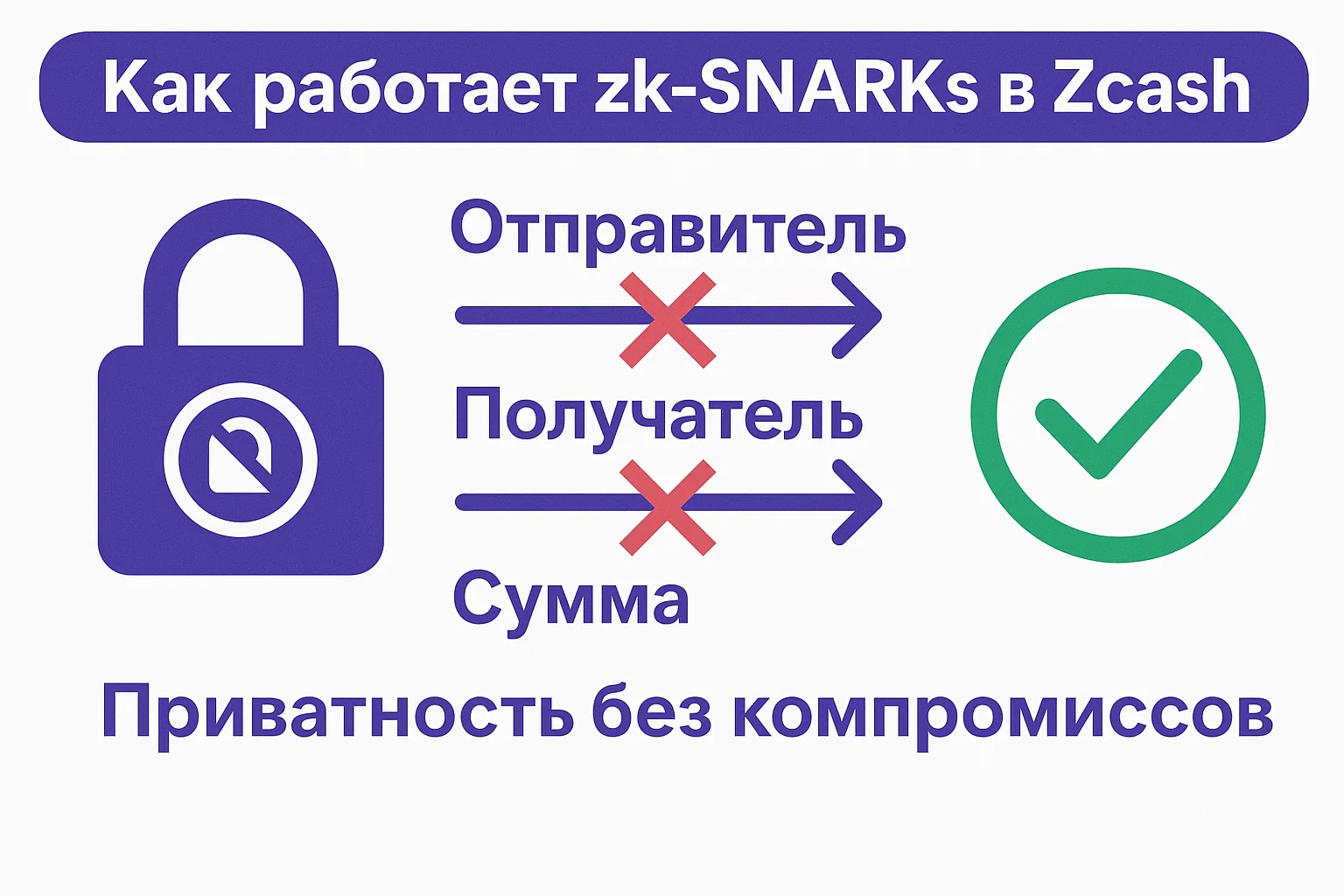
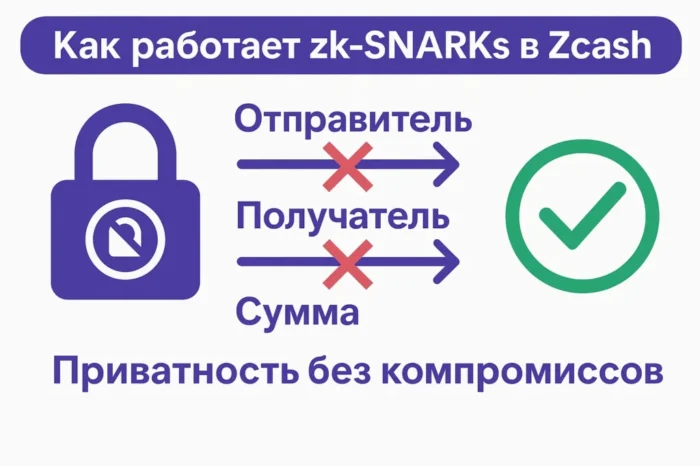
At the heart of Zcash’s privacy technology are zk-SNARKs, a cryptographic method that allows one party to prove that a transaction is valid without revealing any of its details.This technology allows transactions on the blockchain to be completely encrypted, yet they can still be verified as valid according to the network’s consensus rules. When a user selects a z-address for a secure transaction, all that is visible on the public blockchain is that the transaction occurred and fees were paid, but the addresses, transaction amounts, and memo fields are completely encrypted.
Scalability and speed
Zcash operates on similar blockchain principles as Bitcoin, but generally offers faster transaction speeds. Because the network does not have the same level of congestion as Bitcoin, transactions are often processed faster and with lower fees.Target block time is 75 seconds, which is significantly faster than Bitcoin. The current block reward is 1.5625 ZEC(after the second halving in November 2024).
Flexibility and compliance
Unlike Bitcoin, which is completely transparent, Zcash allows users to choose between private and public transactions. This flexibility makes Zcash more attractive to businesses and individuals who need privacy but also need to comply with regulatory requirements.For example, companies that must provide financial statements may use transparent transactions, while individuals who value privacy may choose secure transactions. This selective disclosure feature allows you to comply with regulatory requirements without compromising security.
Monetary policy similar to Bitcoin
Zcash has a maximum supply of 21 million coins – the same as Bitcoin. This creates a clear issuance pattern with predictable halvings. ZEC currently has a circulating supply of about16.3-16.4 million tokens(about 78% of the maximum supply).
Zcash mining difficulty
Zcash Mining Difficulty (Network Difficulty) is a parameter that shows how difficult it has become to find a new block in the Zcash network. This difficulty is automatically adjusted every 150 blocks, approximately every 10.4 hours, to maintain a stable block creation time of 75 seconds.
As of November 2025, the current mining difficulty is approximately97-125 million(depending on the source). This value constantly changes depending on the network hashrate.
The higher the difficulty, the more computing power is required to mine one block and receive a reward. Increasing difficulty usually indicates:
- Increasing number of miners in the network – more profitable mining attracts new participants
- Improved network security – more power makes it harder to attack the network
- Network hashrate growth – the current Zcash hashrate is approximately 10.9-13.9 GH/s (gigahash per second)
As of November 2025, Zcash difficulty and hashrate have reachednew all-time highs, indicating the growing popularity of mining and strengthening network security.
How does Zcash mining work?
Zcash uses the Equihash algorithm for mining. This is a memory-intensive algorithm that was originally designed to be resistant to ASIC miners. However, today there are ASIC miners specifically designed for Equihash, such as the Bitmain Antminer Z15 Pro (840 KSol/s, 2780W).Despite the advent of ASIC hardware, GPU mining is still possible because the algorithm rewards memory space more than pure processing power. This means that even small miners with consumer hardware can compete—as long as they operate efficiently.
Distribution of block rewards
When a miner verifies a block, he receives a block reward (currently1.5625 ZEC). Of this reward, 80% goes to the miners, and the remaining 20% is distributed to the Zcash Development Fund, which supports the Electric Coin Company, the Zcash Foundation and community grants.
Zcash halving schedule
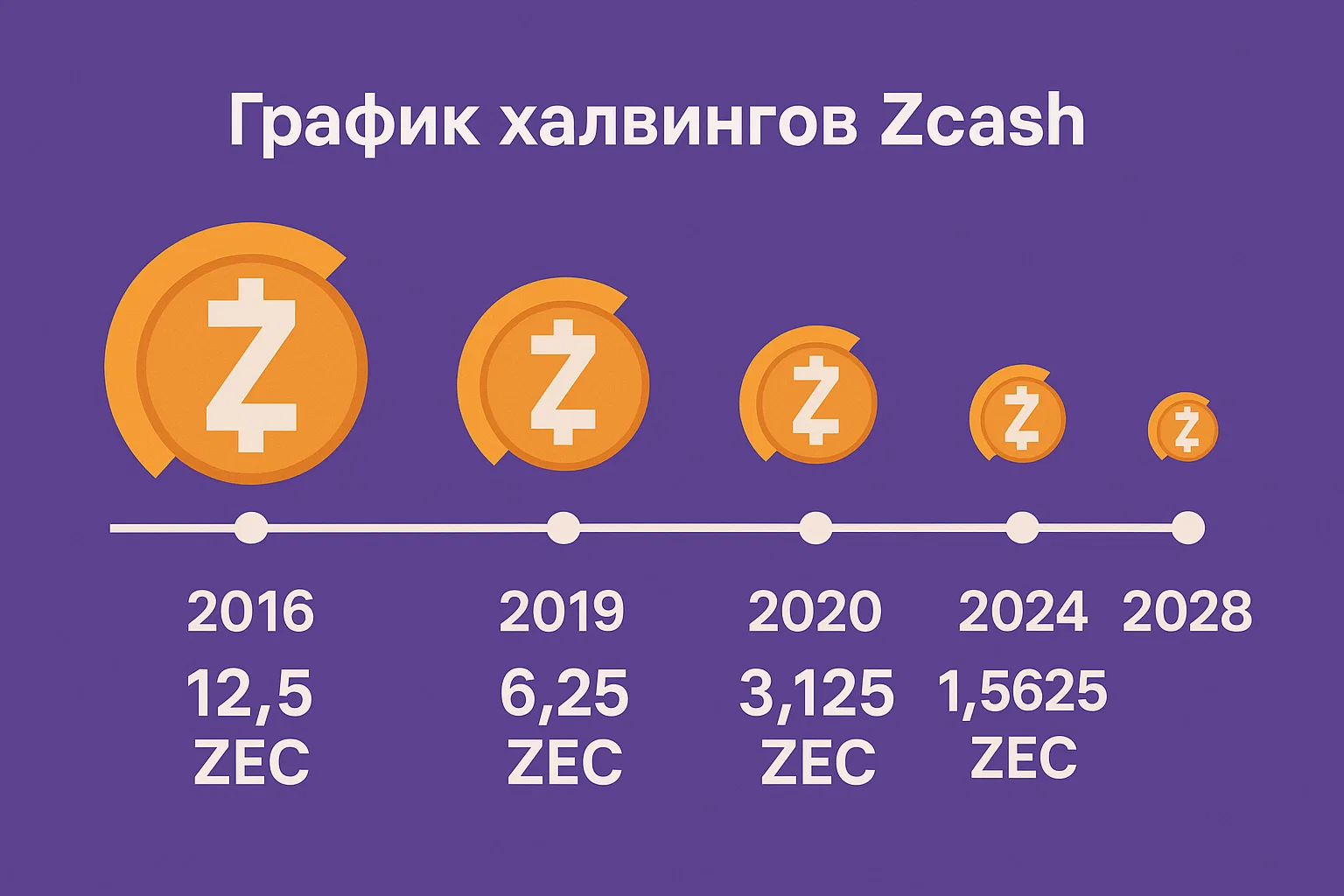
Zcash halving occurs approximatelyevery 4 years. Halving schedule:
- Launch (October 2016): Initial block reward 12.5 ZEC
- December 2019 (Blossom update): Block time reduced from 150 to 75 seconds, block reward reduced to 6.25 ZEC to maintain the same emission rate
- First halving (November 18, 2020): reward decreased from 6.25 to 3.125 ZEC
- Second halving (November 23, 2024): reward decreased from 3.125 to 1.5625 ZEC
- Third halving (expected at the end of 2028): reward will decrease from 1.5625 to 0.78125 ZEC
Each halving reduces the supply of new ZEC into circulation, which could theoretically keep the price under pressure if demand remains stable or increases.
Zcash structure and ecosystem
Shielded Pool
One of the most important indicators of Zcash’s privacy usage is the growth of thesecure pool—the amount of ZEC stored in secure addresses.
As of the end of 2025, the protected pool reached4.9 million ZECrepresenting about30% of the total supply(compared to 11% at the beginning of 2025). Much of this growth comes from theOrchardpool, a more efficient secure pool introduced in 2022 with easier and faster proofs.The growth of the secure pool indicates a reduction in the circulating supply of ZEC, as secure coins are typically held for long periods rather than actively traded. This creates upward pressure on the price, especially if demand continues to rise.
There are two main teams working on Zcash:
- Electric Coin Company (ECC) supports zcashd and develops the Zashi
- Zcash Foundation supports Zebra, an independent implementation of the Zcash node in Rust
wallet
Zashi Wallet
Zashi is a mobile wallet for Zcash created by Electric Coin Company. This is a self-custody wallet that only supports Zcash and secure transactions by default.
Key features of Zashi:
- Full control over funds – only the user can see, access and manage their ZEC
- User-friendly interface with improved UX
- Support for unified addresses and direct secure transfers
- Integration with NEAR Intents for cross-chain ZEC swaps to other assets
Zashi’s CrossPay feature allows users to pay anyone in another asset (such as BTC, ETH or USDC) while spending ZEC privately. The recipient never touches the ZEC, but the sender’s privacy remains intact.
Zashi is currently only available for iOS and Android, but the community is discussing the possibility of releasing a desktop version.
Zcash Blockchain Explorer
Zcash Explorer (blockchain explorer) is a tool for viewing and analyzing all transactions, addresses and blocks on the Zcash network. Browsers allow any user to track the movement of funds, check the status of transactions and analyze network activity.Popular Zcash Reviewers:
Blockchair (https://blockchair.com/zcash) is one of the most popular and reliable browsers developed by Blockchair. It allows:
- Search blocks, transactions and addresses
- Analyze address balance
- View network statistics (difficulty, hashrate, number of transactions)
- Monitor the state of the mempool (queue of unconfirmed transactions)
Tokenview ZEC Explorer (https://zcash.tokenview.io) is another popular browser with analysis support:
- View recent blocks
- Tracking hashrate and network complexity
- Analysis of 24-hour transaction volumes
- Information about the total offer and the number of addresses
Trezor Zcash Explorer (https://blockbook.zec.zelcore.io) – a specialized browser for Trezor wallets:
- Integrated into Trezor Suite
- Shows detailed information about blocks and transactions
- Monitors network complexity in real time
ZCatch is a new promising browser specifically designed for the Zcash ecosystem:
- Advanced visualization of transparent and secure transactions
- Analysis support for future encrypted assets (ZSA)
- Bridge between privacy and transparency
Browser Features:
Despite the privacy of Zcash, blockchain observers fully expose transparent transactions (t-addresses) as they work like Bitcoin. Secure transactions (z-addresses) are completely hiddenin the blockchain and are not visible in the browser – this is a key privacy feature of Zcash.
The browsers also provide an API for developers who want to integrate Zcash data into their applications.
Why is Zcash growing in 2025?
Zcash has experienced impressive growth in 2025, rising over700-845% YTDand reaching prices above$680. This rise is driven by several key factors:
- The revival of the privacy and anti-surveillance narrative
As cryptocurrencies are becoming increasingly regulated around the world, the demand for financial privacy and protection from government oversight is growing. Zcash—built on zero-knowledge cryptographyzk-SNARKs—allows completely private transactions where the sender, recipient, and amount remain hidden.Analysts point to an “anti-surveillance wave” in the crypto space, with investors looking to Zcash as aprivate alternative to Bitcoinin an era of growing demands for transparency and financial oversight.
- Large network upgrades and increased adoption
Recent updates to the Zcash network, including Orchard Shielded Pool and Zashi wallet integration, have significantly improved usability and security.As of November 2025,over 30% of all ZECs circulate through secure addresses—a new record for the project. This shift not only signals a strengthening of Zcash’s privacy layer, but also a rise in the anonymity set, making transactions more difficult to track.
At the same time, this happened:
- New exchange listings and launch of derivatives markets, increasing liquidity
- Expanding the ecosystem of applications using Zcash privacy
- Growth of network nodes to record levels, increasing decentralization
- Technical breakthrough and restoration of alts
Technically, Zcash broke through long-term resistance levels, which triggered a wave of short-squeeze and attracted high-volume traders. As major cryptocurrencies such as Bitcoin and Ethereum consolidate, traders are looking for high-beta assets for yield.
With low supply (21 million), growing momentum and positive fundamentals, Zcash has emerged as one of the leading candidates. Data shows thatZEC has significantly outperformed Monero, Dash and Litecoinover the past month, reclaiming its position asthe leading privacy coin.
- Growing key network indicators
As of November 2025, the Zcash network has reached new milestones:
- Mining difficulty at historical highs, which improves security
- Network hashrate is growing, indicating increasing power to support the network
- The number of nodes has reached new peaks, minimizing the risk of service failure and attacks
- Secured transactionscontinues to expand through Sapling and Orchard pools
These indicators indicate not only speculative demand, but also the actual use of the network for private transactions.
Where to buy and store Zcash coin?
Top 3 Cryptocurrency Exchanges for buying ZEC by trading volume:
- Binance – supports trading pairs USDT, USDC, BTC, ETH, BUSD
- MEXC Global – supports USDT pair
- KuCoin—supports USDT pair
Other popular exchanges include Kraken, Coinbase, OKX, Gate.io, Bitfinex and more.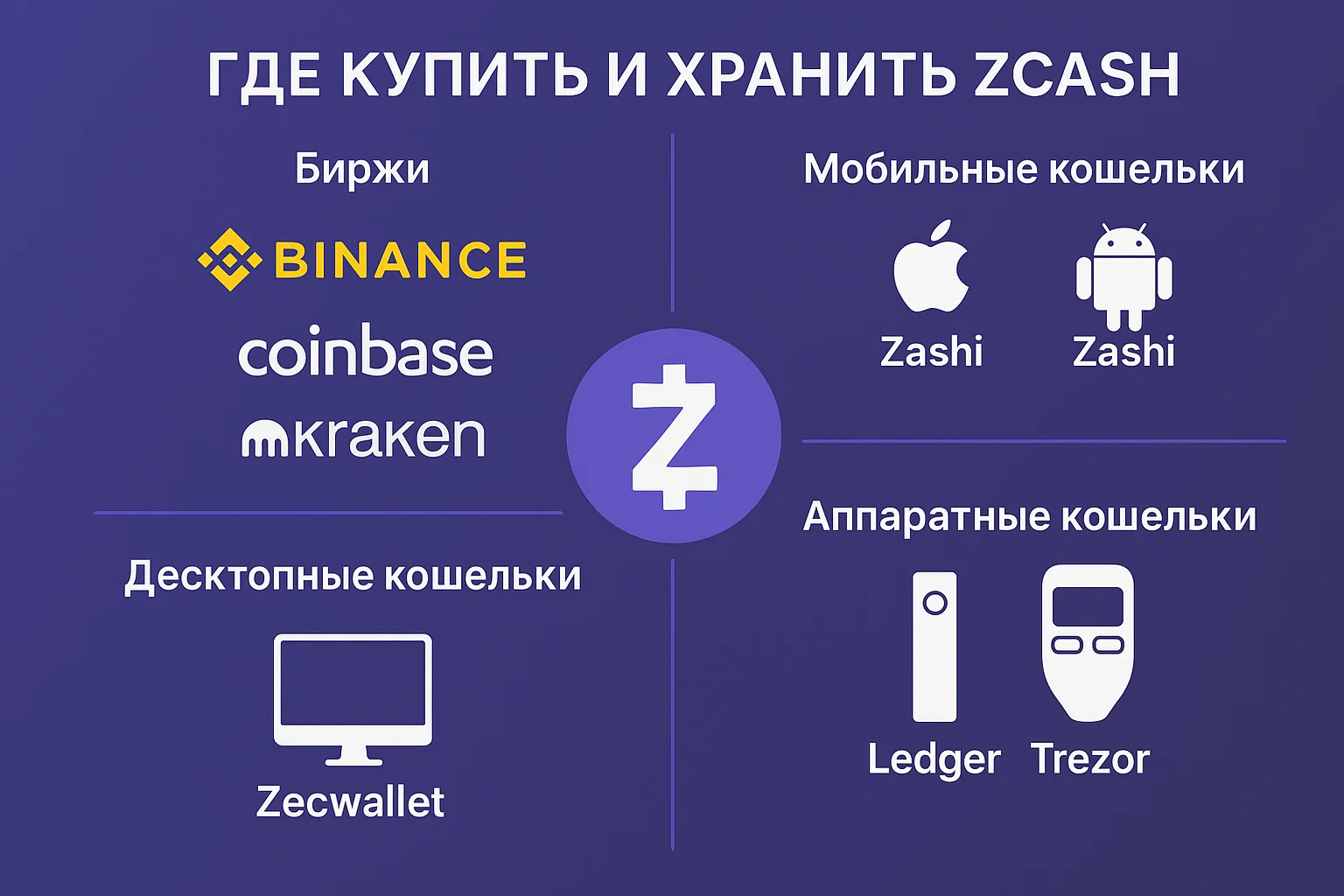
Fiat currencies are suitable: the American dollar (USD) or the euro (EUR). Most exchanges require a minimum deposit of around $50.
Important aspects when purchasing:
- All platforms have varying degrees of liquidity and security – study their features before choosing them
- Each platform has its own interface – in some places it is simpler, in others it is more complex
- Buying ZEC for dollars is easier than for other cryptocurrencies
- There is no direct way to buy ZEC with cash
- Many exchanges only support transparent addresses (t-addresses) for deposits and withdrawals due to regulatory requirements
Recommended steps for purchasing ZEC:
- Select an exchange – register on one of the listed platforms
- Go through KYC verification – provide the necessary documents (passport, residential address)
- Top up your account – transfer fiat money (USD, EUR) or other cryptocurrency
- Place an order – buy ZEC at the market or limit price
- Withdraw to wallet – move ZEC from the exchange to a secure wallet (if you plan on long-term storage)
Where to store Zcash
You can store Zcash in different types of wallets:Mobile wallets:
- Zashi (iOS and Android) – official ECC wallet with support for secure transactions by default
- Atomic Wallet – supports ZEC for iOS and Android
Desktop wallets:
- Zecwallet Lite – full-featured secure wallet, synchronizes in less than a minute, does not require blockchain download
- Zecwallet Fullnode – works with a local Zcash full node, can run over Tor for added privacy
Hardware wallets:
- Ledger – supports ZEC
- Trezor – supports ZEC
- Keystone – Receives multisig support as part of the Q4 2025 roadmap
It is Recommended to use wallets that support secure addresses (z-addresses) by default for maximum privacy.
Zcash price history
Zcash has a volatile price history.
When launched in October 2016, initial demand for the privacy coin was so extreme and supply so limited that during the first week, ZEC prices on exchanges briefly soared above $5,000. However, these transactions were one-off speculative in nature with almost zero supply of coins, so this surge is not considered representative of the all-time high.The current all-time high was reached in January 2018 – at the peak of the overall crypto boom – and was around $868 per coin.
Price history by year:
2019: from $27.57 to $59.48
2020: from $28.05 to $63.99
2021: from $33.08 to $217 (beginning of year $154, end of year $38.10)
2022: from $37.34 to $211.97
2023: from $26.88 to $51.08
2024: from $27.80 to $78.71
2025: ZEC experienced impressive growth, increasing around 1000% YTD, reaching prices above $600-$750 in late October/early November 2025. As of the end of November 2025, ZEC was trading in the range of$500-$676, representing an11-33% decline from the year’s highbut still up845%+ from the start of the year.
Zcash Applications and Partnerships
Partnership with JPMorgan
One of the most significant partnerships in Zcash history was the collaboration with JPMorgan Chase, announced in May 2017.
JPMorgan has integrated the Zero-Knowledge Security Layer (ZSL)—Zcash’s zero-knowledge security layer—into its Ethereum-based enterprise blockchain called Quorum.
This integration allowed Quorum to provide confidential settlement of digitized assets on a distributed ledger using the same zk-SNARKs cryptographic technology as Zcash. The partnership also included Microsoft, whose Azure Blockchain-as-a-Service platform adopted Quorum.
Corporate applications
Companies are increasingly adopting private blockchain systems for secure payments, internal payments and compliant data exchange.
Main use cases:
- Confidential financial transactions – parties can verify the authenticity and compliance of a transaction without revealing key details
- Selective Disclosure – Users can disclose transaction data to auditors or partners as needed while maintaining confidentiality from the general public
- DeFi integration – privacy layers using zero-knowledge proofs are built into decentralized finance protocols
Current development and roadmap Q4 2025
Electric Coin Company announced its roadmap for the fourth quarter of 2025, with a focus on improving privacy features and usability.
Key priorities:
- Adding Sapling addresses for all ZEC swaps via NEAR Intents protocol to strengthen private transactions
- Automatic creation of short-term “ephemeral” addresses for swaps to protect user identity
- New behavior of transparent addresses – creating fresh addresses after receiving funds for an additional level of privacy
- Multisig support for Keystone hardware wallet for more secure storage options
Advantages and limitations of Zcash
Key advantages:
- Selective Privacy: Secure transactions allow users to hide amounts and counterparties while maintaining a public option.
- Monetary policy similar to Bitcoin: fixed supply of 21 million and predictable halvings maintain clear issuance over time.
- Iterative network updates: improved proof performance and usability.
- View-only access: Enables auditing for accountants or compliance teams without revealing spending authority.
- Cross-chain integration: Features like CrossPay and integration with NEAR Intents make Zcash a stealth payment layer for other blockchains.
- Regulatory Flexibility: Unlike Monero, which provides mandatory privacy for all transactions, Zcash offers optional privacy, making it more acceptable to regulators and exchanges.
Limitations and risks:
- Low adoption of secure transactions: Actual activity is still skewed toward transparent transactions, so the secure pool may be less than ideal for anonymity, especially when users move funds in recognizable patterns: transparent → secure → transparent.
- Computational complexity: Fully protected transfers have historically required more computation than public ones (although this has improved with major updates).
- Uneven wallet support: Support and UX remain uneven across providers.
- Regulatory pressure: Policy pressure has led to periodic delistings of privacy coins in certain markets, limiting privacy rails.
- Delistings: In 2025, a total of 73 exchanges worldwide were delisting privacy coins – an increase of 43% compared to 51 exchanges in 2023. The European Parliament has voted in favor of a bill that would ban the listing of tokens like Zcash and Monero, with rules coming into force in 2027.
Zcash vs Monero: main differences
Zcash and Monero are two leading privacy coins, but they have different approaches.
Privacy:
- Monero: mandatory privacy for all transactions – all transactions are private by default
- Zcash: optional privacy – users choose between transparent and secure transactions
Technology:
- Monero: uses Ring Signatures, Stealth Addresses and Confidential Transactions (RingCT)
- Zcash: uses zk-SNARKs (zero-knowledge proofs)
Regulatory status:
- Monero: Delisted from major exchanges including Binance, OKX and Huobi due to AML regulation concerns
- Zcash: continues to trade freely on compatible platforms
Interchangeability:
- Monero: considered fully fungible since all coins are indistinguishable
- Zcash: Transparent transactions can be monitored, potentially leading to certain coins being blacklisted
Philosophy: Monero is for uncompromising privacy maximalists who reject oversight. Zcash, on the other hand, combines privacy with flexibility.
Frequently asked questions
How much is 1 Zcash worth?
The price of 1 Zcash (ZEC) coin is constantly changing. As of December 2025, ZEC was already trading in the region of$200–$220. And in March 2026 the price of the coin is $211. The current price can be viewed on exchanges or in CoinMarketCap.
What is ZEC coin?
ZEC coin is a cryptocurrency of the Zcash blockchain platform that offers enhanced privacy through zk-SNARKs technology, scalability and low fees.
What is the all-time high price of Zcash?
Zcash’s all-time high was around $868 and was reached in January 2018 during the general boom of the cryptocurrency market. The short-term surge to $5,000+ in the first days after the launch in October 2016 is not considered a real ATH – at that moment the supply of coins on the market was minimal, and transactions were sporadic in nature.
Why is Zcash growing in 2025?
Zcash is growing due to: (1) the revival of the privacy narrative in the face of increased regulation, (2) large-scale network upgrades (Orchard, Zashi) and the growth of real use of secure transactions (30% of all ZEC), (3) technical breakthrough with the breakdown of long-term resistance, (4) reaching new highs in mining difficulty, hashrate and number of nodes.
Today, the Zcash cryptocurrency represents a unique combination of advanced privacy technology and regulatory flexibility. The cryptocurrency market is very volatile, so before buying and trading any crypto coin, each trader needs to conduct their own analysis and calculate the risks. Learning to trade on the stock exchange will be a necessary help in this matter.
DISCLAIMER
Important Disclaimer: This article is provided for educational purposes only and does not constitute financial advice, investment advice, or an offer to buy, sell or hold Zcash (ZEC) cryptocurrency or any other financial instrument.
Risks associated with cryptocurrencies:
- Extreme volatility: Cryptocurrency prices, including ZEC, are subject to wild fluctuations and you could lose your entire investment in a matter of hours or days.
- No Guarantee: Cryptocurrencies are not guaranteed by any asset, government or financial institution.
- Regulatory Risk: Cryptocurrency regulation is evolving and new regulations could significantly impact the cost and availability of ZEC.
- Cybersecurity risk: Hacking of wallets, exchanges and other platforms can lead to loss of funds.
- Technical Risk: Bugs, code vulnerabilities, or network attacks could negatively impact Zcash.
Recommendations:
- Invest only funds that you can afford to lose.
- Do your own research (DYOR) before any investment decision.
- Consult a qualified financial advisor.
- Use reliable wallets and exchanges.
- Never share private keys and seed phrases with third parties.
The author of this article is not responsible for any damages resulting from the use of the information in this article.

Crypto market analyst with seven years of experience in blockchain technologies and digital asset investing. Active in the cryptocurrency space since 2017, having navigated multiple bull runs and bear market cycles. Specializes in blockchain project analysis, crypto exchanges, DeFi, and investment strategies. Dedicated to helping readers navigate and understand the digital asset economy.